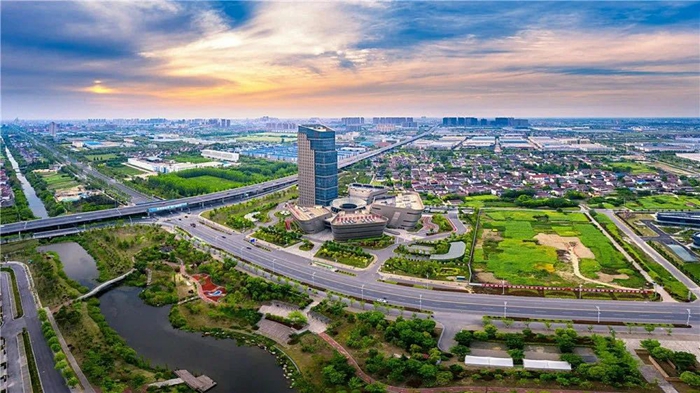
A sweeping view of Taizhou city. [Photo/WeChat ID: tzfabu]
Geography
Taizhou city is located in the central part of East China's Jiangsu province, bordering the Yangtze River to the south, Yancheng city to the north, Nantong city to the east and Yangzhou city to the west. As such, it is one of the central cities in the Yangtze River Delta region.
Area
The total area of Taizhou covers 5,787.98 square kilometers, of which the land area accounts for 78.81 percent and the water area occupies 21.19 percent. The urban area stretches out 1,567.75 sq km.
Administrative divisions
Taizhou administers three county-level cities of Jingjiang, Taixing and Xinghua and it also had three districts: Hailing, Gaogang and Jiangyan. It includes 61 towns, two townships, 25 sub-district offices, 1,164 village committees and 547 neighborhood committees.
History
Taizhou, known as Haiyang in the Qin Dynasty (221-206 BC), Hailing in the Han Dynasty (206 BC-AD 220) and Taizhou during the Southern Tang Dynasty (937-975), has a recorded history of more than 2,100 years.
During the Southern Tang Dynasty, it was upgraded from a county to a state and became known as Taizhou. It is a place where the cultures of the Wu, Yue and Chu states were integrated, and customs in the Yangtze River and the Huaihe River regions combined.
Demography
By the end of 2025, Taizhou's population reached 4.77 million, with an urbanization rate of 71.70 percent, up 0.82 percentage points from the previous year. The city includes 51 ethnic minority groups, with over 17,000 people, from the Tujia, Miao, Zhuang, Hui, and Manchu ethnic groups, making up 0.36 percent of the city's total population.
Economy
During the 14th Five-Year Plan period (2021-25), the city's gross domestic product is projected to have reached 730 billion yuan ($105.24 billion), while GDP per capita exceeded 160,000 yuan. The income gap between urban and rural residents is forecast to have narrowed to 1.82:1, reflecting more inclusive growth.
Total retail sales of consumer goods increased by more than 200 billion yuan compared with the previous five-year period, and cumulative imports and exports are expected to surpass $100 billion.
Taizhou has become the fifth city in Jiangsu province to have all of its counties surpass a GDP of 100 billion yuan. Taixing Economic Development Zone and Taizhou Port Economic Development Zone have remained among the province's top 10 development zones, while Xinghua, Hailing and Jiangyan high-tech zones have been upgraded to provincial-level status.
For the 15th Five-Year Plan period (2026-30), Taizhou has set clear and forward-looking targets. The city aims to achieve average annual GDP growth of more than 5 percent, with GDP per capita approaching $30,000. R&D expenditure is expected to account for over 3.3 percent of GDP, underscoring a stronger focus on innovation-driven development.
City Tree and Flower
Taizhou's official city tree is the ginkgo, and the city flower is the plum blossom.
With over 1,400 years of cultivation, Taizhou is home to the Ancient Ginkgo Forest Park in Taixing, a significant ginkgo ecosystem in China and globally.
The region also has a rich history of cultivating plum blossoms, featuring a variety of species that enhance its natural landscape.
Local Culture
Taizhou celebrates a variety of traditional festivals, including the Spring Festival, Lantern Festival, and Mid-Autumn Festival, with the Spring Festival being the most significant. This festival features diverse cultural activities, such as performances by opera, music, and dance troupes from both urban and rural areas.
The Lantern Festival is marked by lantern riddles, displays, and floating lanterns, while Tomb-Sweeping Day, Zhongyuan Festival, and the Winter Solstice serve as important occasions for ancestor worship.
Major temple fairs are held in the region, such as the Tangdian Temple Fair in Hailing district, the Qintong Temple Fair in Jiangyan district, and the Gushan Temple Fair in Jingjiang. The Qintong Boat Parade, the oldest and largest of its kind, is well-known.
With a history of over 2,100 years, Taizhou has a rich tradition in folk arts and opera, including Peking Opera, Huaiju Opera, and Xiju (Wuxi Opera). The city has produced many cultural figures, such as Shi Nai'an, Zheng Banqiao, and Mei Lanfang. The city boasts cultural and historical landmarks such as Guangxiao Temple, Chongru Temple, City God Temple, Anding Academy, Rishe Garden, Wanghai Tower, Mei Lanfang Memorial Hall, and the Memorial Hall of the Birthplace of the PLA Navy.
Transportation
Taizhou city in Jiangsu province is an important transportation hub connecting the north and south and is the gateway to central Jiangsu.
It is also an important node city for the Shanghai metropolitan area and the Nanjing metropolitan area.
The Xinyi-Changxing Railway, Nanjing-Qidong Railway, Beijing-Shanghai Expressway, Nanjing-Nantong Expressway, Yancheng-Jingjiang Expressway and Qidong-Yangzhou Expressway run across the entire city. Six railway lines starting from Taizhou Railway Station connect the city with hundreds of other cities throughout the country.
Taizhou also boasts the Yangzhou Taizhou International Airport, as well as the Jiangyin Yangtze River Bridge and the Taizhou Yangtze River Bridge.
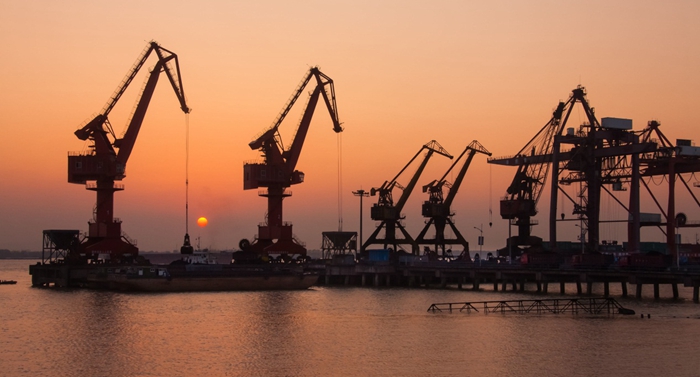
An enchanting view of Taizhou Port at dusk. [Photo provided to etaizhou.gov.cn]
The State-level open port Taizhou Port is an influential logistics facility with an annual throughout capacity of 400 million metric tons.
The superior location and the integrated structure of the roads, railways, water and air underscores the city's important position in the northern wing of the Yangtze River Delta.