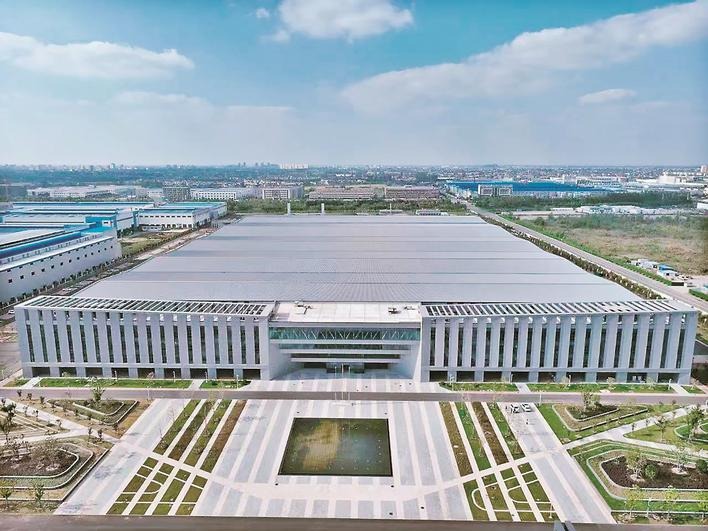
The assembly workshop of Kaifei Aerospace in Jingjiang, Taizhou. [Photo/Taizhou Daily]
In the Jingjiang Economic and Technological Development Zone, the first phase of the Xinkong Rocket Propulsion Industrial Park is rapidly taking shape.
"The first phase will be completed and put into operation by the end of next year, with 240 sets of high-grade equipment to be installed. Once operational, it will produce 150 units of 100-metric-ton-thrust liquid oxygen–kerosene rocket engines annually," said Zhao Hui, deputy general manager of Xinkong Aviation.
Zhao noted that the company's technical team includes senior aerospace experts and has already overcome key bottlenecks in engine cycle system design and thermal protection material development. "We are also developing a 220-ton-thrust rocket engine, with the goal of building an aerospace industrial park capable of producing 600 rocket engines a year."
Nearby, in the assembly workshop of Kaifei Aerospace, the scale is equally impressive — nearly 20 meters high and covering more than 40,000 square meters. With the first aircraft tail section delivered, the company has entered mass production. At full capacity, output value is expected to reach 10 billion yuan ($1.39 billion).
With over 5 billion yuan in total investment, the Kaifei project is meant to become a world-class civil aircraft component base integrating design, R&D, manufacturing, and supply.
In the low-altitude sector, Jiangsu Yuanshi Aviation Technology in Jiangyan district has developed a proprietary planetary reducer system, enabling engines to achieve three hours of endurance and a 10-ton commercial payload. The first batch of ten prototypes is now in production.
"Although Taizhou lacks a historical aerospace industry base, our strong high-end equipment manufacturing industry and innovation ecosystem give us the ability to leapfrog in this future-oriented sector," said Ma Yangyang, deputy director of the Taizhou Science and Technology Bureau.
A 2024 research report shows that the city currently has 30 manufacturing enterprises capable of supplying the aerospace sector, many of which could transition to serve it directly. However, without a fully formed industrial cluster, several companies remain in a wait-and-see mode.
"Rocket engines are massive system projects, with tens of thousands of individual parts. They involve computer simulation, digital blueprinting, intelligent manufacturing, precision machining, high-accuracy testing, and specialized metal materials," Zhao from Xinkong Aviation explained.
"We need a large number of supporting enterprises and products. The demanding standards for processes and materials in rocket engine production will also drive technological upgrades across the parts manufacturing industry."